

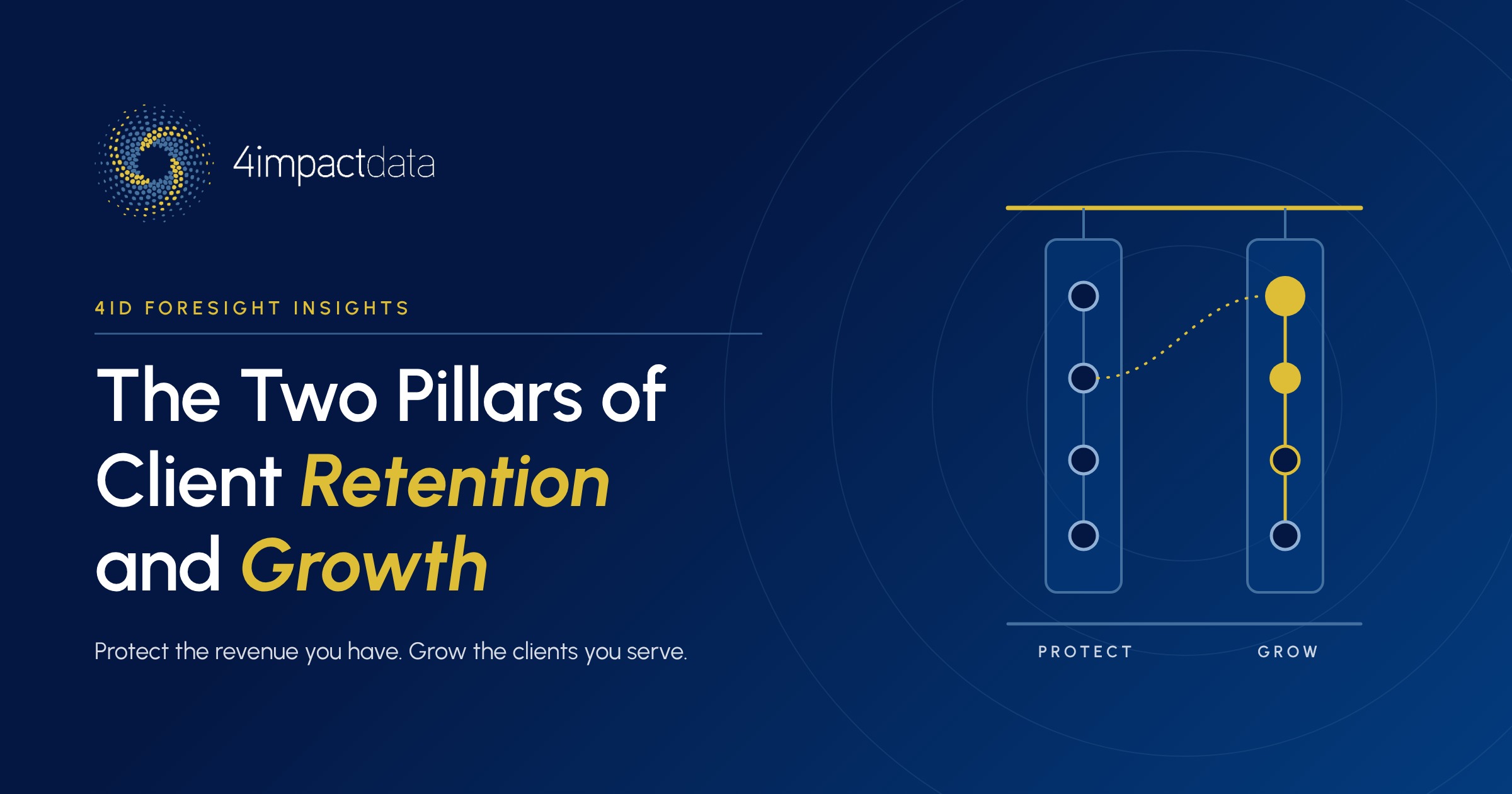
Quick answer: A client retention and growth strategy for CPA firms rests on two pillars. The first protects existing revenue by identifying at-risk clients early enough to help. The second grows revenue from the existing book by showing which clients are ready for more. Firms that run both pillars from the same view of every client turn retention and growth into one repeatable process.
Most firms manage retention and growth as separate jobs. Retention belongs to whoever owns the relationship, and growth belongs to business development and the search for new logos. As a result, neither one runs on a consistent process, and both depend on which partner happens to be paying attention.
Meanwhile, clients are asking for more. In ClearlyRated’s 2026 survey of accounting buyers, 91% want proactive input from their firm, yet only 27% say their firm initiates those conversations. In the same research, only 10% of clients say they are unlikely to switch firms under any circumstances.
That gap is where firms lose clients and leave revenue unclaimed. This guide explains the two pillars, why they belong in one strategy, and how managing partners can put both to work.
What Are the Two Pillars of a Client Retention and Growth Strategy for CPA Firms?
The two pillars are protect and grow. Protecting means keeping the revenue the firm already earns by seeing risk before it reaches the relationship. Growing means expanding revenue inside the client base by meeting needs clients already have. Together, they answer two questions every managing partner should be able to answer about every client: who needs attention now, and who is ready for more?
Why CPA Firms Need One Client Retention and Growth Strategy
Retention and growth draw on the same information. A slide in margins, rising cash volatility, or a growing dependence on one customer can signal risk for one client and an unmet need for another. When the firm reviews the whole book through one lens, every review produces both kinds of insight.
The client relationship also links them. Clients who receive proactive guidance have more reasons to stay and more reasons to buy. According to the 2026 Accounting Buyer Insights Report:
- 78% of clients are likely to purchase additional services in the next 12 months.
- 50% expect to increase spend with their primary firm, compared with 5% who expect to decrease it.
- 90% would pay more for proactive risk identification.
At the same time, expectations keep climbing. Wolters Kluwer’s 2026 research found that managing client expectations moved from the fourth to the second biggest challenge facing accounting firms. A firm that treats retention and growth separately has to meet those expectations twice. A firm with one strategy meets them once, consistently.
Pillar 1: How to Protect the Revenue You Already Have
Client departures rarely come without warning. Financial pressure builds for months in the form of thinning margins, slower collections, tighter cash, or concentration in a single customer. By the time the client raises it, options are limited, and the firm is reacting instead of guiding.
The protect pillar replaces reaction with early visibility. In practice, that means:
- Reviewing the full book. Look at every client on a regular cadence, not just the accounts that call or the ones a partner happens to open.
- Watching leading indicators. Track margin trends, cash runway, receivables, and customer concentration rather than waiting for year-end results.
- Ranking who needs attention now. No team can meet with every client every month, so prioritize the relationships where early help protects the most revenue.
- Starting the conversation first. The firm that calls before the client asks becomes the partner the client is reluctant to leave.
Service consistency matters just as much. In the ClearlyRated research, repeated errors or quality issues were the top reason clients would consider leaving, cited by 46%. A protect strategy covers both the client’s business health and the quality of the firm’s own delivery. For a closer look at early warning signs, see how to spot at-risk accounting clients 18 months before they leave.
Pillar 2: How to Grow Revenue From the Clients You Already Serve
New client acquisition is slow and expensive. Growth from the existing book builds on trust the firm has already earned, and the need is often already there. Many clients outgrow their current services long before anyone offers them more.
The grow pillar turns those needs into specific offers. In practice, that means:
- Matching services to what the numbers show. A client with rising cash volatility may need forecasting. A client with thinning margins may need pricing or profitability analysis. A client adding locations may need budgeting and planning support.
- Prioritizing by likely impact. Rank opportunities across the whole book so partners know which clients to call this week.
- Packaging the offer. Insight only becomes revenue when the client can say yes to a defined scope with a clear price.
- Tracking conversion. Measure which conversations turn into engagements, then refine the approach.
Growth from the book also strengthens retention. Each new service deepens the relationship and gives the client another reason to stay. Learn more in how to uncover hidden revenue in your client base and why advisory is retention insurance, not an upsell.
How to Tell Which Pillar Needs Attention
Most firms are stronger in one pillar than the other. A few patterns make the gap visible:
- Protect is missing if client departures surprise the team, even though the financial trends were visible months earlier.
- Grow is missing if new service revenue comes mainly from new clients rather than the existing book.
- Both are missing if advisory conversations happen only with a handful of vocal clients while the rest of the book receives compliance work alone.
How to Build a Client Retention and Growth Strategy for CPA Firms
A strategy that covers both pillars does not require a large program. It requires a shared view, a steady rhythm, and clear ownership.
- Start with one view of every client. Map the full book by health, risk, and opportunity before chasing new logos.
- Set a monthly review rhythm. Review the whole portfolio on the same schedule so nothing depends on memory.
- Standardize the questions. For each client, every advisor asks: Is this client at risk? What do they need next? What should we offer? Who owns the next step?
- Assign ownership. Every flagged client gets an owner, a next step, and a date.
- Measure both pillars. Track retained revenue, new engagements from existing clients, and advisor capacity, not just activity.
- Scale in stages. Prove the process with one partner group, then expand firm-wide. For practical steps, see how to get firm-wide buy-in for a client growth system.
How 4ID Foresight Supports Both Pillars
Each step above is achievable manually, but few firms have the capacity to sustain it across hundreds of relationships. 4ID Foresight, the client retention and growth system from 4impactdata, is built around both pillars. It connects with QuickBooks Online and Xero, with other platforms available on request.
- Portfolio Monitor (protect): Continuously monitors the firm’s entire client portfolio to identify developing risks 18 to 24 months before they escalate. Its Business Health Indicator renders every client as a color-coded tile in a heatmap, organized into Primary, Secondary, and Tertiary tiers.
- Opportunity Map (grow): Reveals unrealized revenue in the existing book, prioritizing Revenue and Margin Analysis, Revenue Pipeline and Sales Conversion, and Customer and Product Profitability, down to the project plan, suggested pricing, and call sheet.
Behind both is Codified Wisdom®, which encodes the expertise of top-performing advisory teams so every advisor works from the same playbook. Firms have the potential to protect an estimated $1 million to $2 million in revenue and surface an estimated $2 million to $3 million in new opportunities per 100 clients, without adding headcount.
Frequently Asked Questions
It is a repeatable process for protecting existing revenue and expanding revenue within the current client base. It rests on two pillars: identifying at-risk clients early enough to help, and identifying which clients are ready for additional services.
Both depend on the same view of client health. The same review that reveals a client in distress also reveals a client ready for forecasting or pricing work, so running them together saves time and produces more consistent guidance.
Financial warning signs such as declining margins, slower collections, and customer concentration often build for months. With portfolio-wide monitoring, firms can see developing risk 18 to 24 months before it escalates.
Start with one partner’s book. Review every client for risk and opportunity, track what those conversations produce, and expand once the results make the case.
Track retained revenue, revenue from new engagements with existing clients, conversion of identified opportunities, and advisor capacity.
Ready to put both pillars to work across your client base? Talk to an Expert