

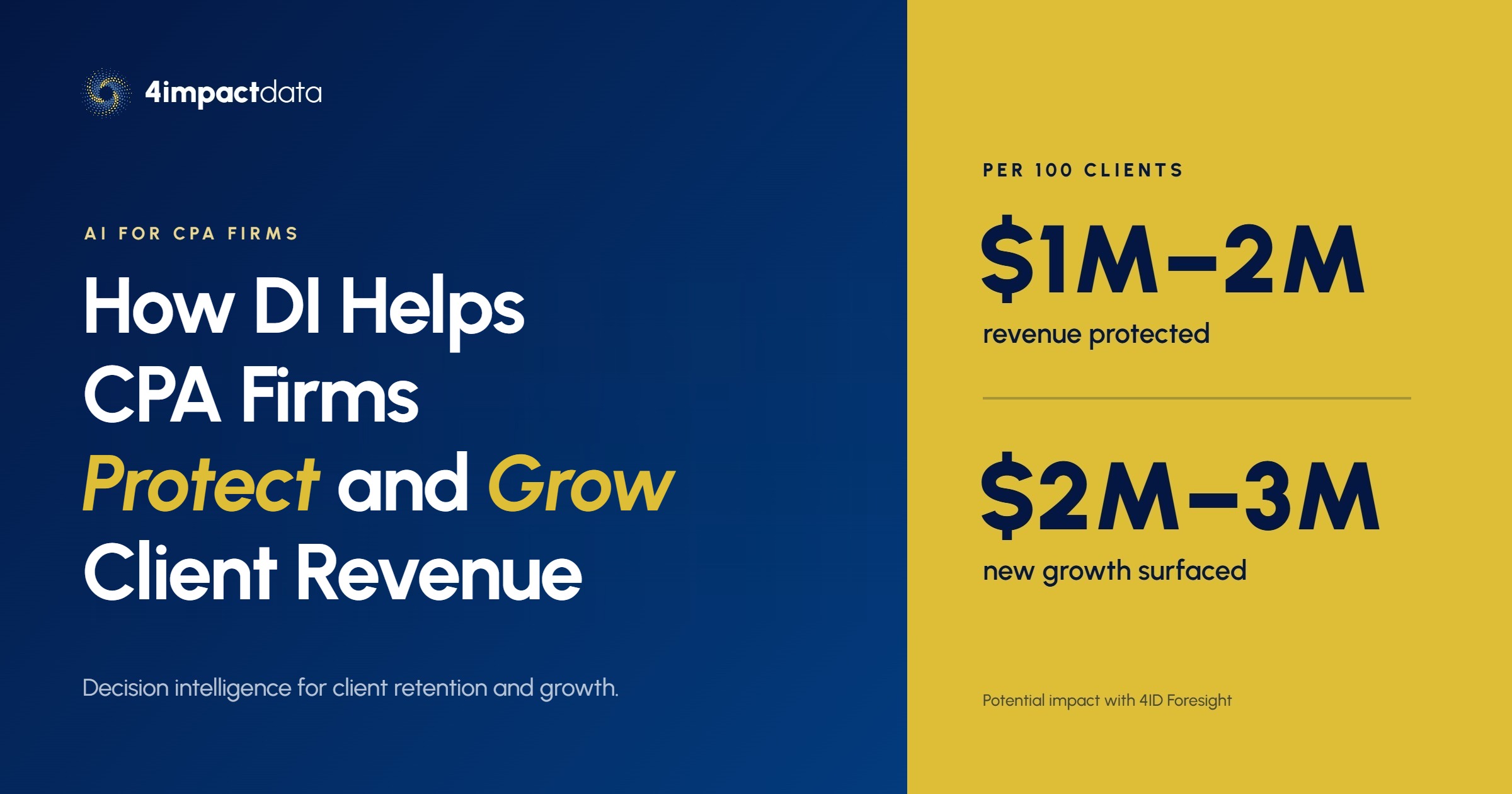
Quick answer: AI for CPA firms saves time on research, drafting, and document review, but time savings alone do not protect or grow revenue. Firms that grow pair those efficiency gains with decision intelligence (DI), which reviews the full client portfolio, surfaces at-risk clients early, and shows advisors which clients are ready for more help and what to do next.
Most CPA firms have already adopted AI in some form. Tax research runs faster. Documents get summarized in seconds. Close cycles shrink. However, time savings alone do not change a firm’s revenue trajectory.
Adoption has moved quickly. In the 2026 Blue J and CPA.com survey of more than 1,000 tax professionals, 60% use AI for tax research at least weekly, up from 33% a year earlier. In addition, 84% agree it saves time.
Yet a gap is opening between adoption and value. According to Thomson Reuters’ Future of Professionals 2026 research, 91% of professionals believe their organizations fall short of the technology’s potential. Closing that gap starts with a question most AI tools are not designed to answer: which clients need attention, and why?
Why AI for CPA Firms Stops at Time Savings
Efficiency tools compress the hours tied to compliance work. That is useful, but it also compresses fees. As a result, firms that stop at efficiency often end up doing the same work for less.
Clients are also raising the bar. Thomson Reuters found that 78% of corporate clients view technology-enabled quality improvements as essential. However, only 6% say their providers actually deliver them. Meanwhile, 32% of clients plan to reassess provider relationships within 12 months.
In other words, the real risk is not falling behind on AI. It is losing clients to firms that turn their tools into better guidance.
What AI Alone Cannot Tell Your Firm
Many firms start by uploading financial reports into general-purpose AI tools. That approach can summarize information quickly. However, AI answers the question it is given. It cannot tell an advisor which of 300 clients matters most this month, or which question to ask in the first place.
Professionals already know this. In the Thomson Reuters tax and accounting report, 94% of tax and audit professionals require outputs grounded in authoritative content, and 90% require explainable, defensible reasoning. Advisory needs context, benchmarks, and judgment, not just faster summaries.
AI for CPA Firms vs. Decision Intelligence: What Is the Difference?
AI for CPA firms generates outputs: research answers, summaries, and drafts. Decision intelligence focuses on the decision itself. It organizes work around the recurring questions advisors face, such as which clients need attention, why, and what to do next.
| AI tools | Decision intelligence | |
|---|---|---|
| Primary job | Generate answers, summaries, and drafts | Prioritize decisions and next steps |
| Starting point | The question a user asks | The full client portfolio |
| Scope | One task or document at a time | Every client relationship, every month |
| Output | Text that still needs interpretation | Ranked priorities with context and a clear next step |
| Business impact | Saves time on existing work | Directs time to the clients where it protects or grows the most revenue |
In short, AI makes the work faster. Decision intelligence helps determine which work matters most. For background, read what decision intelligence platforms are and why they matter now.
How Decision Intelligence Protects Existing Revenue
Client departures rarely come without warning. Instead, the warning signs sit in places no one reviews consistently. For example, a customer concentration problem, a slow slide in margins, or a pattern of late payments can build for months.
Decision intelligence helps in three ways:
- Monitor every relationship. Review the full client portfolio every month, not just the accounts a partner happens to open.
- Surface risk early. Identify developing issues 18 to 24 months before they escalate, while there is still time to help.
- Prioritize attention. Rank which clients need a conversation now, so advisors spend time where it protects the most revenue.
Because advisors see problems while they are still small, the firm becomes the partner that called first. That is the kind of relationship clients are reluctant to leave. For a closer look, see how to spot at-risk accounting clients 18 months before they leave.
How Decision Intelligence Grows Revenue From the Existing Book
The same visibility that protects revenue also reveals growth. Many clients outgrow their current services long before anyone offers them more. For instance, a client with rising cash volatility may need forecasting. Another with thinning margins may need pricing or profitability analysis.
Decision intelligence surfaces those needs across hundreds of clients at once. Then it ranks opportunities by likely impact, so partners know which five clients to call this week.
This matters because new client acquisition is slow and expensive. By contrast, growth from the existing book builds on trust the firm has already earned. Learn more in how to uncover hidden revenue in your client base.
How 4ID Foresight Puts Decision Intelligence to Work
4ID Foresight, the client retention and growth system from 4impactdata, is built on decision intelligence, not AI. Rather than generating answers to prompts, it applies Codified Wisdom®, the judgment of top-performing advisory teams captured as structured logic, consistently across every client in the portfolio. It connects with QuickBooks Online and Xero, with other platforms available on request.
- Portfolio Monitor: Continuously monitors every client to identify developing risks 18 to 24 months before they escalate. Its Business Health Indicator renders each client as a color-coded tile in a heatmap, organized into Primary, Secondary, and Tertiary tiers.
- Opportunity Map: Reveals unrealized revenue in the existing book, down to the project plan, suggested pricing, and call sheet.
Because the logic is codified, every advisor works from the same playbook, and every priority comes with the context behind it. Firms have the potential to protect $1 million to $2 million in revenue and surface $2 million to $3 million in new opportunities per 100 clients.
4ID Foresight also works alongside the AI tools a firm already uses. AI speeds up the work. 4ID Foresight shows which clients that work should serve first.
How CPA Firms Can Move Beyond AI Time Savings
Keep the AI tools that save your team time, and add visibility on top of them. First, pick one partner’s book and review it for risk and opportunity. Then track what those conversations produce. Finally, expand once the results make the case.
Frequently Asked Questions
Most firms use it for tax research, document analysis, drafting, and advisory project support. In a 2026 Blue J and CPA.com survey, 60% of tax professionals used it for tax research at least weekly.
AI generates outputs such as research answers, summaries, and drafts. Decision intelligence (DI) focuses on the decision itself: which clients need attention, why, and what to do next. AI makes the work faster, while DI helps determine which work matters most.
AI can speed up analysis once a firm knows which client to examine. Reducing churn depends on knowing which clients are at risk in the first place. Decision intelligence reviews the full client portfolio, so firms can see warning signs like margin erosion or customer concentration months in advance and reach out before the relationship is in jeopardy.
No. 4ID Foresight is built on decision intelligence. It applies Codified Wisdom®, the judgment of top-performing advisory teams captured as structured logic, to every client in the portfolio. It also works alongside the AI tools a firm already uses.
No. AI speeds up tasks, and decision intelligence surfaces what matters and suggests next steps. Advisors still provide the judgment, context, and client relationship.
See what AI alone cannot show you about your client base. Talk to an Expert